If you own, lease or manage a commercial property in Melbourne, there is almost certainly a backflow prevention device on the water connection, and the law requires it to be tested every year by a plumber holding backflow accreditation. This guide covers commercial backflow prevention in Melbourne from end to end: which businesses need a device, which device, what annual testing involves, what your water authority expects afterwards, and where commercial sites most often fall out of compliance.
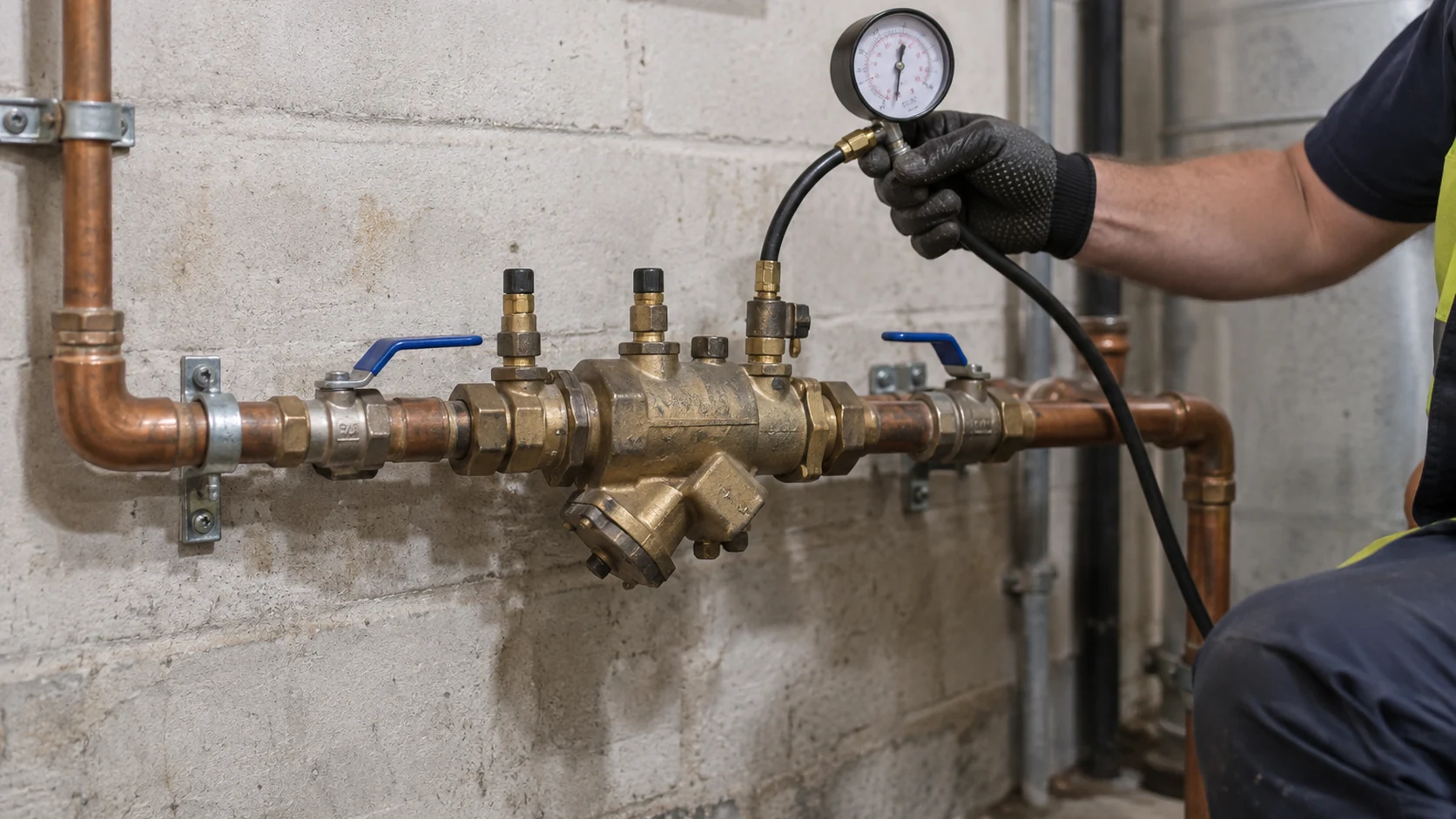
What Commercial Backflow Prevention Actually Means
Backflow is water running the wrong way. Melbourne's mains are designed to push water into your property under constant pressure, but a burst main, a fire brigade drawing on a hydrant, or a pump on your own site can reverse that. When it does, whatever your plumbing is connected to can be drawn back toward the public supply: chemical dosing lines, commercial dishwashers, irrigation, cooling towers, wash bays, medical equipment.
A backflow prevention device is a mechanical valve that only lets water travel one way. On a commercial site, protection is applied in layers:
- Containment protection sits at the boundary, immediately after the water meter, and protects the public network from everything on your property. This is the device your water authority is most concerned with, and it is the one that appears in their register.
- Zone protection isolates a higher-risk section of the building, such as a commercial kitchen, a laboratory or a plant room, from the rest of the property's plumbing.
- Individual protection sits at a single fixture or piece of equipment: a dishwasher, a bidet, a dental chair, a chemical mixer.
Most Melbourne businesses have a containment device at the meter and, depending on what happens inside, one or more zone or individual devices as well. Every testable device on the site has to be tested annually, not just the one at the boundary.
Which Commercial Properties Need a Backflow Prevention Device?
Every property connected to the Melbourne water network is assessed for backflow risk by its water authority (Yarra Valley Water, South East Water or Greater Western Water) and given a hazard rating under AS/NZS 3500.1. The rating decides whether a device is required and what type.
| Hazard rating | What it means | Typical Melbourne commercial sites |
|---|---|---|
| High | Backflow could cause serious illness or death | Hospitals, medical and dental clinics, veterinary practices, laboratories, car and truck wash bays, chemical and food manufacturing, commercial laundries, sites with cooling towers or chemical dosing, private fire services with additives, mortuaries, abattoirs |
| Medium | Backflow could affect health but is unlikely to be life-threatening | Restaurants, cafes and commercial kitchens, hotels and motels, schools and childcare centres, gyms and aquatic centres, office buildings with plant rooms, retail centres, warehouses and distribution centres, service stations, sites with in-ground irrigation |
| Low | Backflow would affect taste or colour only | Small offices and shops with standard domestic-style plumbing and no special connections |
In practice, almost every commercial site in Melbourne rates at least medium. A shop that fits out a kitchen, a warehouse that adds a wash bay, or an office that installs irrigation for the landscaping moves up the scale, and the water authority expects the device to move with it.
If you are not sure how your site is rated, your water authority's notice or your last test report will say. If you have never received one, the safest assumption is that a device is required and that it has not been registered.
The Devices You Will Find on a Commercial Site
The hazard rating sets the minimum device. Commercial sites in Melbourne generally carry one or more of the following:
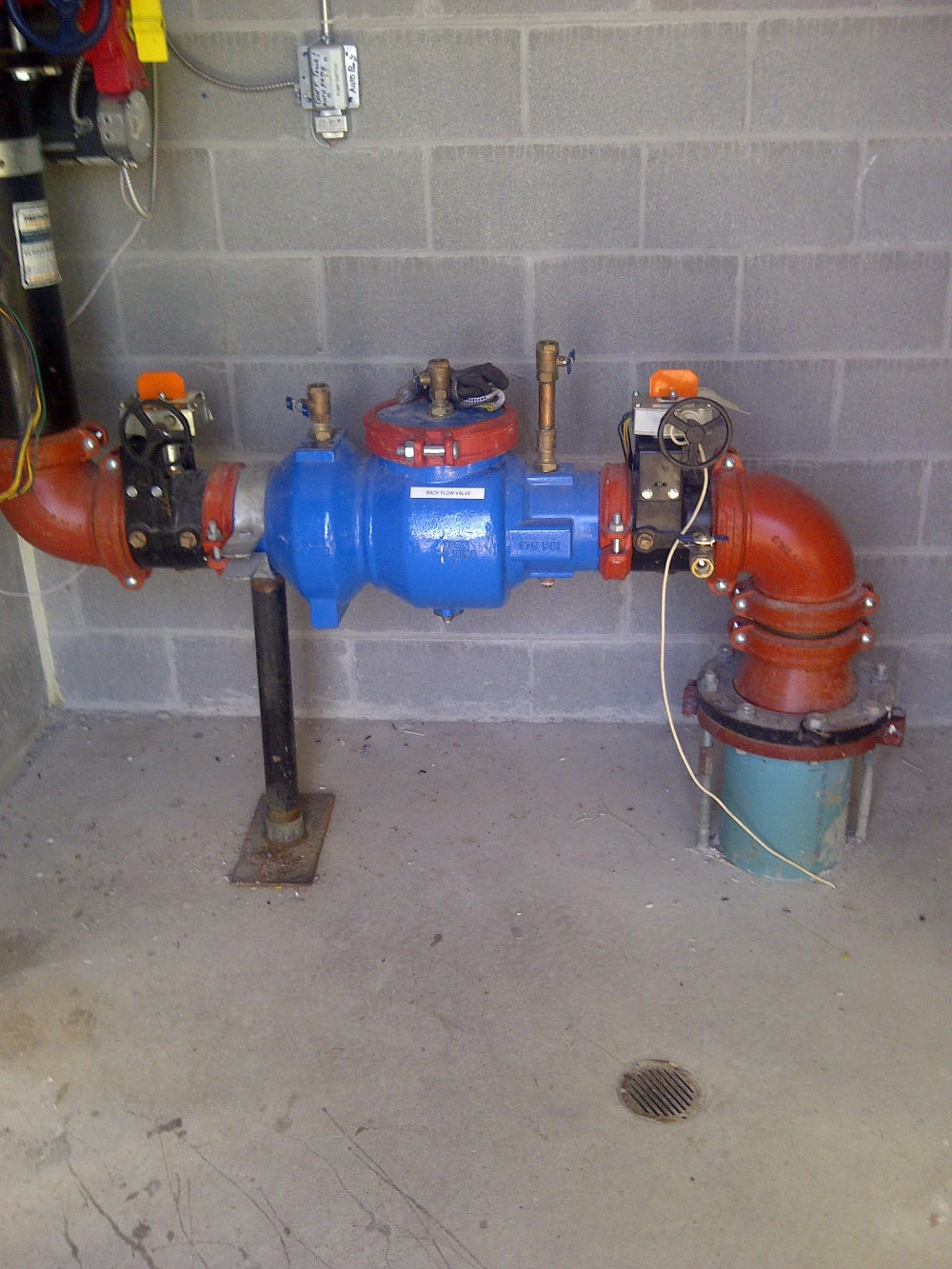
- Reduced Pressure Zone (RPZ) valve. Required for high hazard connections. Two independent check valves with a pressure-monitored relief valve between them that discharges to drain if either check fails. The RPZ is the device that gives the most protection, and it is the one most often found guarding fire services, commercial kitchens, medical premises and industrial processes. See our guide to RPZ valve testing and installation.
- Double Check Valve (DCV). The standard testable device for medium hazard connections: two independent check valves in series, with test cocks so each can be verified. Common at the meter on retail, office, school and warehouse sites.
- Detector assemblies on fire services. Private fire services are protected with a double check detector assembly or an RPZ detector assembly, which combine the backflow device with a bypass meter so small flows (leaks or unauthorised use) are still metered. These are tested like any other testable device.
- Registered air gaps and break tanks. Where the connection can be physically separated, a registered air gap or break tank provides high hazard protection without a mechanical device. Air gaps still need an annual inspection to confirm they remain compliant. See air gap testing.
- Non-testable dual check valves. Fitted at low hazard connections. They are not tested annually, but they are still a compliance item and are replaced rather than repaired.
For a breakdown of how each device works, read backflow prevention valves explained.
Annual Testing: What the Law Requires
Three things are settled in Victoria and apply to every commercial property in Melbourne:
- Every testable backflow prevention device must be tested at intervals of no more than 12 months. The requirement sits in the Plumbing Regulations 2018 and the water authorities' own containment policies, and the test itself is carried out to AS/NZS 2845.3.
- Only a licensed plumber holding the backflow prevention specialised class can test the device and sign the report. General plumbing registration is not enough. The Victorian Building Authority maintains the register, and every report we lodge carries our licence number.
- The property owner is responsible. Not the tenant, not the facilities contractor, not the water authority. A lease can pass the cost on, and many do, but the notices are issued to the owner and the owner answers for a missed test. Owners who manage sites through an agent or a body corporate should confirm in writing who is booking the test each year. Our guide to backflow testing in Melbourne covers what the test involves in detail.
Installation and replacement work is also restricted: a new device must be installed by a licensed plumber, tested on commissioning, and registered with the water authority. The commissioning test starts the annual clock.
What Happens on Test Day
A commercial backflow test is straightforward if the site is prepared. The tester will:
- Locate and identify every testable device on the property and confirm it matches the water authority's record
- Isolate the device, which interrupts the water supply downstream for the duration of the test, usually 20 to 40 minutes per device
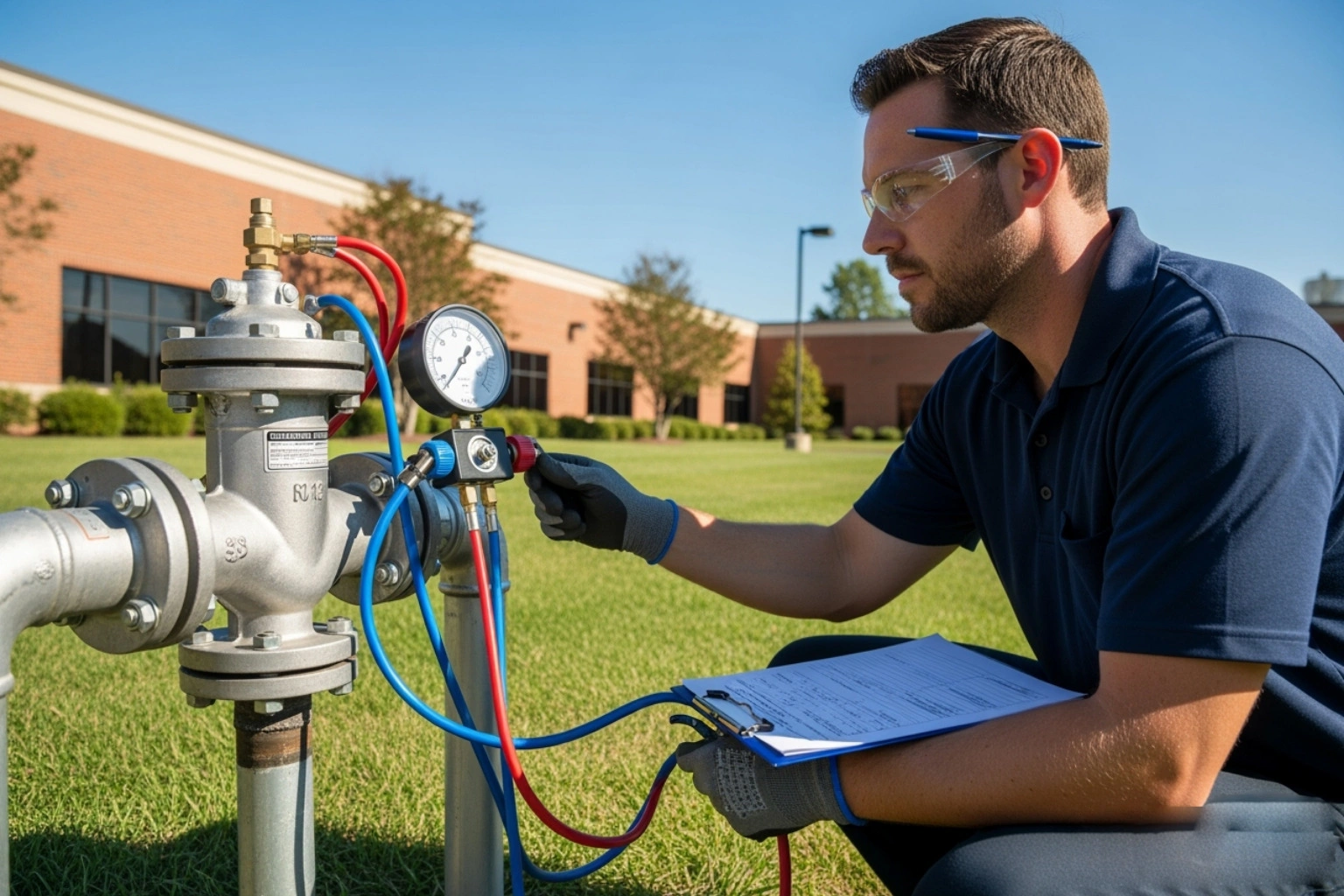
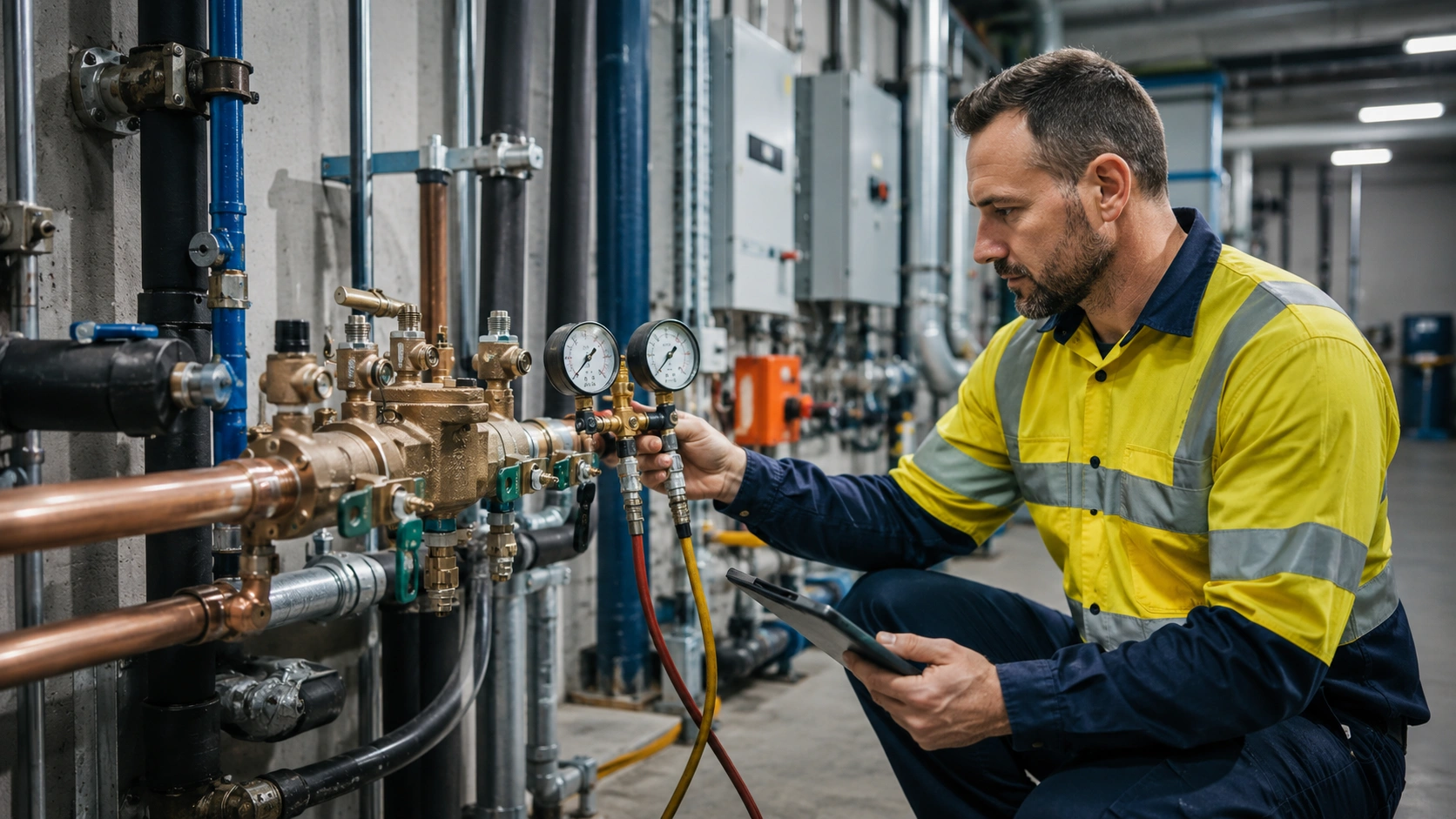
- Connect a calibrated test kit to the test cocks and measure each check valve and, on an RPZ, the relief valve
- Record the readings, the device details and the pass or fail result on the inspection and maintenance report
- Restore supply and, where a device has failed, advise what repair is needed and, in most cases, carry it out on the same visit
For a business, the isolation is the part that needs planning. A cafe, a medical practice or a manufacturing line cannot lose water mid-shift, so commercial tests are booked around the site's operating hours, and sites with several devices are done in a single visit so supply is only interrupted once per zone.
Reporting to Your Water Authority
A passed test is not the end of the obligation. The completed inspection and maintenance report has to reach the water authority within its reporting window, and the window is not the same across Melbourne:
- Greater Western Water (west and north-west): report within 14 days of testing. See the Greater Western Water compliance guide.
- Yarra Valley Water (north and east): report within 20 business days of testing. See the Yarra Valley Water requirements guide.
- South East Water (south and south-east): report within 30 days of testing. See the South East Water compliance guide.
If the report does not arrive, the water authority treats the device as untested, regardless of what happened on the day, and can arrange its own contractor to retest at the owner's expense. We submit every report on the owner's behalf within the window and provide the compliance certificate the same day as the test. Our backflow compliance and reporting service page explains how the submission works for each authority.
Managing Multiple Devices and Multiple Sites
Commercial backflow prevention rarely means one device. A neighbourhood shopping centre in Melbourne commonly carries a containment device at the meter, a detector assembly on the fire service, a device on the irrigation, and zone or individual devices in every food tenancy. A logistics site might have a device at each of several meters plus a wash bay. Each one is tested individually, has its own set of readings, and appears on its own line of the report.
For owners and managers with more than one property, the practical answer is a testing program rather than a series of ad hoc bookings:
- Every device on every site is recorded, with its due date, water authority and hazard rating
- Sites in the same area are tested on the same run, and devices on the same site in the same visit
- Due dates are tracked and reminders go out before a test lapses, not after
- Reports are lodged with the right authority for each site, and certificates are held centrally for audits and lease renewals
This is how we run testing for facilities managers, strata managers and multi-site operators across the suburbs we service, and it is the difference between compliance being a once-a-year scramble and something that simply happens.
Where Commercial Sites Fall Out of Compliance
After years of testing commercial properties across Melbourne, the same problems come up again and again. None of them are complicated, and all of them are avoidable:
- The device is there but nobody owns the due date. The building was connected, the device was commissioned, the report was lodged, and then the tenant changed, the facilities contract changed, and the second test never happened. This is the single most common reason a commercial site receives a notice.
- The device cannot be reached. Landscaping, pallets, a new coolroom, a locked plant room with no key on site. The tester cannot test what they cannot get to, and a site visit that ends without a test still has to be repeated.
- The tenancy changed what the site does. A retail unit becomes a cafe, a warehouse takes on chemical storage, an office adds a commercial kitchen. The hazard rating rises and the device at the meter is no longer adequate, but nobody has told the water authority.
- The fit-out added connections nobody registered. Fit-outs routinely add dishwashers, coffee machines with dosing, bidets, irrigation, and each one may need its own individual device. The base building is compliant; the tenancy is not.
- The fire service was forgotten. Fire service detector assemblies are testable devices and are often overlooked because they sit in a separate cupboard and are treated as the fire contractor's problem.
- A failed test was never followed up. A device that fails has to be repaired and retested, and the retest reported. Sites that treat the first report as the end of the matter are non-compliant until the retest is lodged. See the most common backflow testing failures in Melbourne for what tends to go wrong and why.
What Non-Compliance Means for a Melbourne Business
The water authorities in Melbourne have moved from reminders to enforcement over the last few years, and commercial properties are the focus. A site with an overdue or unreported device can expect, in roughly this order:
- A written notice to the owner requiring the test within a set period
- The authority arranging its own licensed contractor to test the device, and recovering the cost from the owner
- Escalation under the Water Act, which allows the authority to restrict or disconnect the supply to a property that presents an uncontrolled backflow risk
Beyond the authority, an untested device leaves the business carrying the liability if a backflow event contaminates the network or the building's own supply. For food premises, medical practices and childcare centres, that exposure is also a licensing and duty-of-care issue in its own right. Why every Melbourne business must prioritise annual backflow testing covers the business case in more depth.
Frequently Asked Questions
Does every commercial property in Melbourne need a backflow prevention device?
Nearly all do. The water authority assesses each property's hazard rating, and any commercial site rated medium or high hazard requires a testable device at the boundary, with further devices inside where the hazard warrants it. Only a small office or shop with purely domestic-style plumbing is likely to rate low hazard.
Who is responsible for backflow testing on a leased commercial property?
The property owner. The water authority issues notices to the owner and holds the owner responsible for the annual test and the report. A commercial lease can require the tenant to arrange and pay for testing, and many do, but that is an arrangement between owner and tenant; it does not shift the legal responsibility.
How often does a commercial backflow device need testing?
At intervals of no more than 12 months, starting from the commissioning test when the device was installed. Some water authorities also require a test when a device is relocated, repaired or replaced.
Can a commercial site keep operating during the test?
Water is isolated downstream of the device for the duration of the test, usually 20 to 40 minutes per device. Most commercial sites schedule testing outside trading hours or during a quiet period, and where a site has zone devices, only the affected zone loses supply while that device is tested.
What if my commercial device fails its annual test?
The device must be repaired or replaced, retested, and the retest reported to the water authority. Most failures on commercial devices are worn check valve seals, debris in the check valves or a relief valve that has stuck, all of which are usually repairable on the day. Until the retest is lodged, the device is treated as non-compliant.
Do I need a separate test for the fire service?
Yes. A detector assembly on a private fire service is a testable backflow prevention device and is tested and reported like any other. It is commonly missed because it sits apart from the main water service and is assumed to be covered by the fire maintenance contract.
Commercial Backflow Prevention Across Melbourne
Aussie Backflow Testing provides backflow prevention, annual testing, RPZ valve testing, repairs, installation and compliance reporting for commercial, industrial and strata properties across Melbourne, from the industrial estates of Dandenong, Campbellfield and Truganina to the commercial precincts of the inner city and the retail centres of the growth corridors. We are licensed backflow prevention plumbers, VBA Licence No. 28465, and we test, repair and report to Yarra Valley Water, South East Water and Greater Western Water every week.
For sites with several devices, or owners with several sites, we run the testing program: every device recorded, every due date tracked, every report lodged within the window, every certificate issued the same day.
Send us the details of your commercial site or call 0488 410 033 to book annual testing or arrange a site assessment.
This guide is current as of September 2026. Commercial backflow prevention in Victoria is governed by the Plumbing Regulations 2018, AS/NZS 3500.1, AS/NZS 2845.1 and AS/NZS 2845.3, the Plumbing Code of Australia and the backflow prevention and containment policies of each Melbourne water authority. Requirements change; confirm current obligations with your water authority or a licensed backflow prevention plumber.